DESIGN & DEVELOPMENT
BackStory
Timeline
6 months
Team Size
4 people
Role
Design Engineer
Tools




Overview
BackStory is a speculative fact-checking feature embedded directly into TikTok that helps Gen Z verify and understand the context behind posts without ever leaving the app. It pairs community-written notes with aggregated third-party coverage, giving users both the immediacy of crowd consensus and the reliability of real reporting. It aims to answer one simple question for any post: what's the backstory here?
Problem
Checking a claim usually means leaving the app you're currently using and doing the research yourself. That friction is exactly why misinformation spreads faster than users can verify it. Additionally, we've seen more and more that social media is where young people begin learning about the world in the first place.
The stakes here are real, as misinformation carries serious political, health, and financial risks. The COVID-19 vaccine rollout, for example, faced public scrutiny fueled by false claims online, and vaccine hesitancy is now listed by the World Health Organization as one of the top 10 threats to global health.
What made this especially urgent for our target demographic: a large-scale international study of over 66,000 participants across 24 countries found that Gen Z showed greater susceptibility to misinformation than they realized. Their confidence in spotting it didn't match their actual ability (Kyrychenko et al., Personality and Individual Differences, 2025).
How might we help US-based Gen Z social media users quickly verify and label misinformation?
How might we better understand the sources behind misinformation to bolster future detection?
Research
To understand how Gen Z actually encounters and interacts with misinformation day to day, we ran a diary study. This would allow us to focus on the underlying, habitual patterns of our target demographic that might not be captured in a sit-down interview. We did this by organizing everyone into one group chat, and instructed them to write a quick message when they encountered misinformation in their normal social media scroll. We recruited 6 participants, and by the end of the study, they documented 12 instances of misinformation over the course of 3 days. When they reached the end of the study, we conducted exit interviews with each of our participants to reflect on their experiences.
Three insights shaped everything that followed.
Gen Z believes they've already trained their algorithm to handle it.
Participants assumed their feed was “spam-blocked” into safety, which made them more likely to take what they saw at face value.
The fear of missing out outweighs the discomfort of a system they don't fully trust.
Gen Z isn't leaving social media over misinformation concerns — they need to be met where they already are.
Community notes work — but only alongside real fact-checking.
Crowd consensus alone wasn't enough; participants wanted it paired with something more rigorous.
...I couldn't really find any posts to add to diary study. I feel like I spam-blocked people and made my [social media] feed more real.
Nate, 25
I stay on social media since it's the easiest way to stay connected... I hate FOMO.
Kiki, 24
Community Notes helps me clock something false pretty often. I do wish it had something more professional like how Wikipedia does it.
Daniel, 27
Research — diary study screenshots
Ideation
We kept our diary study participants in the loop past the research phase, co-creating the concept with the people who'd actually experience misinformation firsthand. Using our three insights as guardrails, we ran a design studio — context-setting, Crazy 8s, dot-voting to surface the strongest ideas, then a 2x2 mapping feasibility against impact to downselect the features worth pursuing.
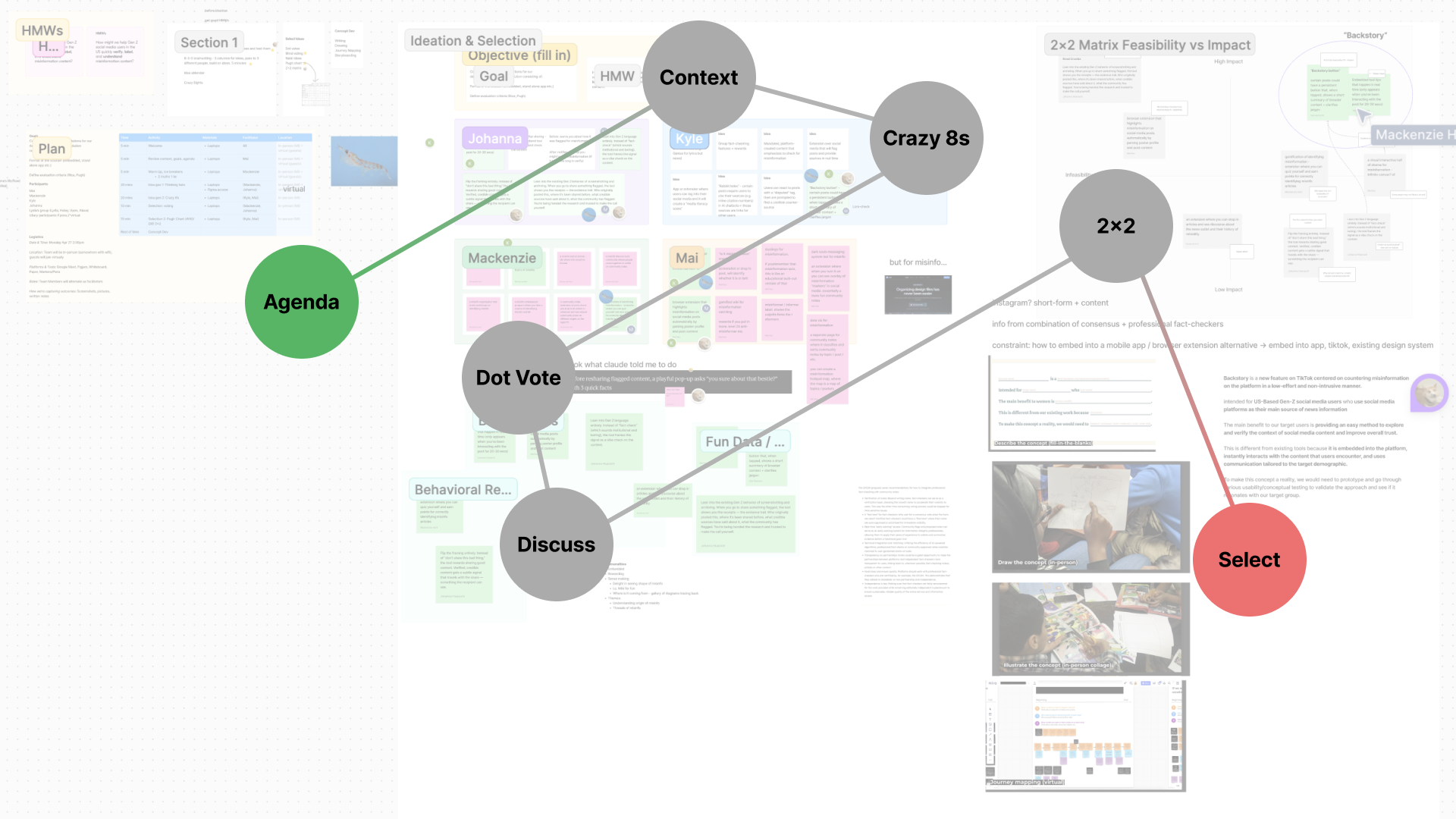
Co-creation Strategy
That process converged on three design principles:
Platform-embedded
No new app or site to learn. BackStory needed to be a built-in, immediately visible feature, not another destination competing for attention.
Gen Z behavior-centric
Designed around the content formats they actually consume. We scoped our case study to TikTok specifically, since it's Gen Z's favorite short-form platform.
Community consensus and fact-checking
Improving on existing models like Community Notes by pairing user-written notes with verified third-party sources, so users get both immediacy and reliability in one place.
Currently, TikTok's own misinformation flags stop at a warning label. They flag a post but don't actually help someone understand it. This gap was our opening.
Solution
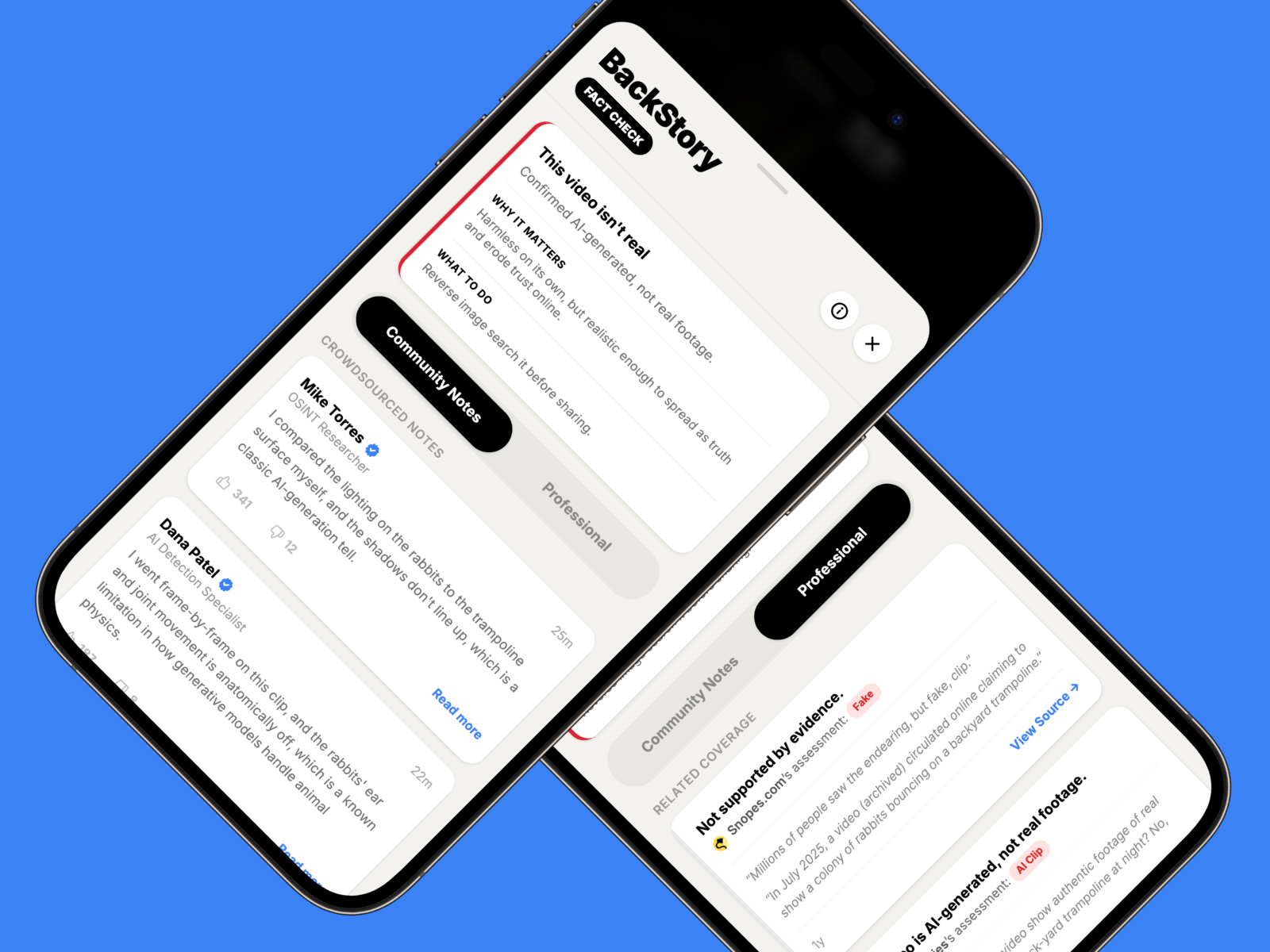
BackStory brings fact-checking directly into the TikTok experience through a tooltip on flagged posts. From there, users can:
- See a generated consensus on the content, why it matters, and what to do next
- Instantly surface community notes from verified users
- View aggregated related coverage pulled via the Google Fact Check Tools API to surface real, third-party fact-checking for added context
- Add their own voice to the conversation or flag content themselves
- Request a BackStory on any post that looks questionable, even before it's been flagged
Together, these turn a passive warning label into an active, two-minute research session without ever leaving the feed.
This solution was very much a team effort, built on ideas we shaped together from the diary study through the design studio. My focus within that shared vision was leading the prototype build using OpenCode, translating our group's decisions into the interactive TikTok experience shown here.
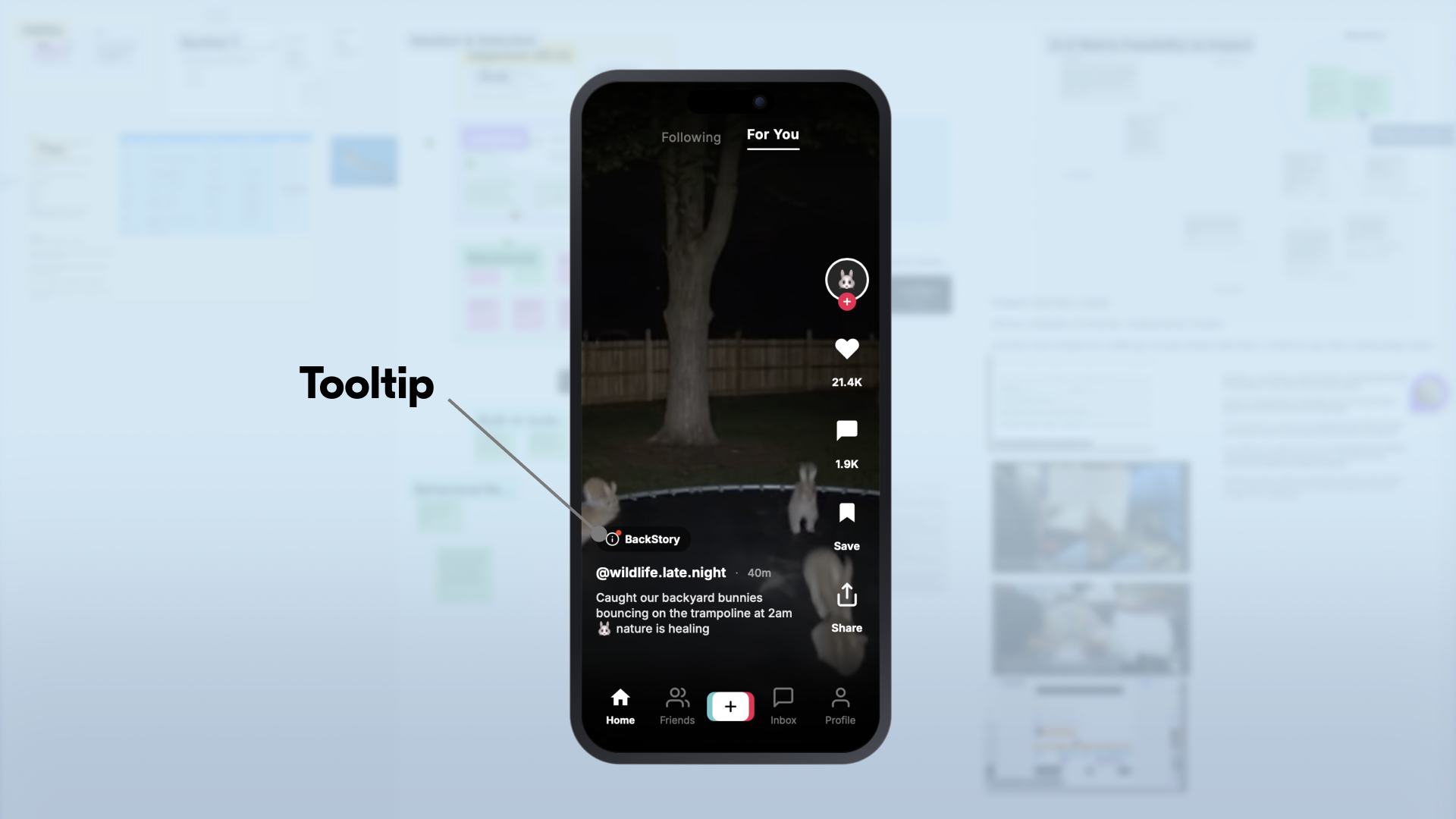
Entry Point — the BackStory tooltip on a flagged TikTok post
Impact
Because BackStory was scoped as a concept rather than a shipped product, we don't have live usage data to report. What follows is our proposed long-term forecast that we designed BackStory to work toward if it were built and adopted.
Output
BackStory empowers users to gather context on social media, engage with community-contributed fact-checking, and conduct independent research using third-party resources, all in one place.
Outcomes
By simplifying the process of identifying and flagging misinformation, BackStory aims to normalize regular fact-checking among US-based Gen Z social media users.
Impact
In the long run, BackStory has the potential to diminish algorithmically-driven polarization, leading to a healthier relationship between society and social media.
Reflections
Co-creation is slower. Sitting with diary study participants through ideation instead of jumping straight to prototyping cost us time we could've spent iterating, but it produced something people will actually use. That collaboration didn't stay in the process; it made it into the product itself. BackStory is, at its core, social infrastructure that helps Gen Z build context together, not a tool that hands them the answer.
The other reflection I keep coming back to is how much setting roles early mattered. We started the project with a team charter covering our methods and rituals, along with each of our individual strengths and weaknesses. I honestly didn't think it would help much at the time, but as the project grew, it was reassuring to already have that foundation in place. Each of us settled into a role that played to our strengths, and our communication stayed sharp the whole way through.
Acknowledgements
Thank you to Johanna, Mackenzie, and Mai for building this with me, and to Sarah for pushing us to design with our users instead of for them.